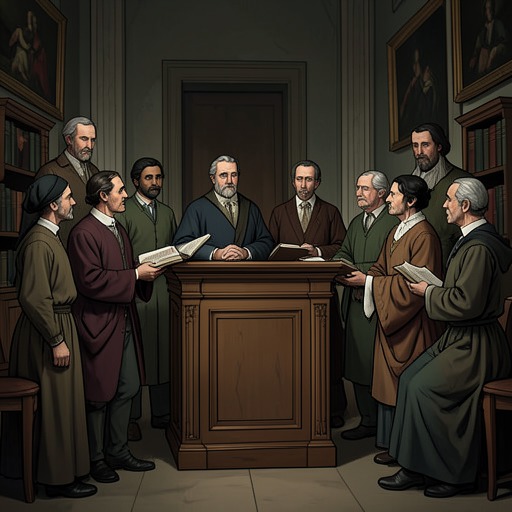
James Bainham
Wolf HallJames Bainham is a barrister whose return to the faith he had been forced to renounce exposes the cost of religious conviction under Tudor rule. His story moves from torture and recantation to public witness, imprisonment, and execution, while Thomas Cromwell confronts the limits of political intervention on his behalf.
Identity and First Recantation
Bainham is identified as a barrister and a member of the legal community at the Inns of Court. Thomas Cromwell recalls that Thomas More had taken him up the previous year and subjected him to torture. In December, Bainham abjured his heresies before the Bishop of London and was released by February. The account presents that recantation not as a settled change of belief but as a choice made under pressure: he wanted to live, yet freedom did not bring him peace.
Return to Public Witness
After his release, Bainham could not sleep with the consequences of what he had sworn. One Sunday he entered a crowded church, stood before the congregation with Tyndale’s Bible in his hand, and openly professed his faith. The act reversed the function of his earlier confession: instead of speaking under interrogation to secure release, he spoke publicly at the risk of renewed punishment. He was arrested again and held in the Tower, awaiting the date set for his execution.
Cromwell understands the predicament without pretending he can resolve it. When Hugh Latimer proposes visiting Bainham, Cromwell hesitates: he fears that an appeal to recant once more might weaken Bainham’s resolve, while the outcome already seems fixed. He concludes that mercy will not operate for him and that he must burn. In this account, the possibility of survival through another recantation has narrowed into a conflict between the will to live and the conscience that cannot accept silence.
Execution and Its Political Setting
Bainham’s execution was fixed for 30 April. At Smithfield, Cromwell attended among the dignitaries and met the Venetian ambassador Carlo Capello, who challenged him about whether he was present as a friend of the heretic or by virtue of his office. The question makes Bainham’s death a public test of Cromwell’s political position as well as a punishment of the prisoner. Wrapped in flames, Bainham called on Thomas More to be forgiven.
The execution takes place amid an intensifying contest over who may define religious authority in England. The king’s government advances the claim that Parliament can determine the realm’s religious jurisdiction; its opponents maintain that spiritual authority lies beyond Parliament’s reach. Bainham’s case gives this institutional dispute a human consequence: a man’s public profession of scriptural faith is treated not merely as belief but as an offence punishable by death.
Narrative Role and Significance
Bainham’s trajectory is brief but consequential: torture, abjuration, release, renewed profession, imprisonment, and execution. The contrast between the released man who had recanted and the prisoner who publicly returned to his faith prevents his story from being reduced to a simple account of unbroken resistance. His recantation registers fear and the desire to live; his later act shows that survival alone could not settle the demands of conscience.
For Cromwell, Bainham also sharpens the moral limits of political calculation. Cromwell considers whether he might advise another oath, privately doubting whether such counsel could help, but recognizes that Bainham’s position has passed beyond a practical bargain. His execution belongs to a wider pattern of coercion against religious reformers, while its remembered final appeal to More connects the violence to the very officials who had enforced it. Bainham thus embodies the collision between conscience, the authority of Scripture, and a state increasingly prepared to make religious conformity a matter of law.